
Who Really Owns Carnival? The 200-Year-Old Battle for the Mas
As the calendar turns toward the middle of April, the Caribbean enters a unique cultural transition. The colorful road marches in Jamaica have just concluded. Consequently, the energy is already shifting toward the “Summer of Mas.” Islands like St. Lucia, St. Vincent, and Barbados are now preparing for their own historic celebrations. When we analyze Caribbean Carnival history, we see that these dates represent more than just a party; they are a timeline of reclamation.
To the casual observer, Carnival looks like a whirlwind of sequins, soca, and sunshine. However, a 200-year-old story of transformation lies beneath the feathers. This narrative explains how the people seized an elite, exclusionary festival. They dismantled it and rebuilt it into a grassroots movement of freedom.
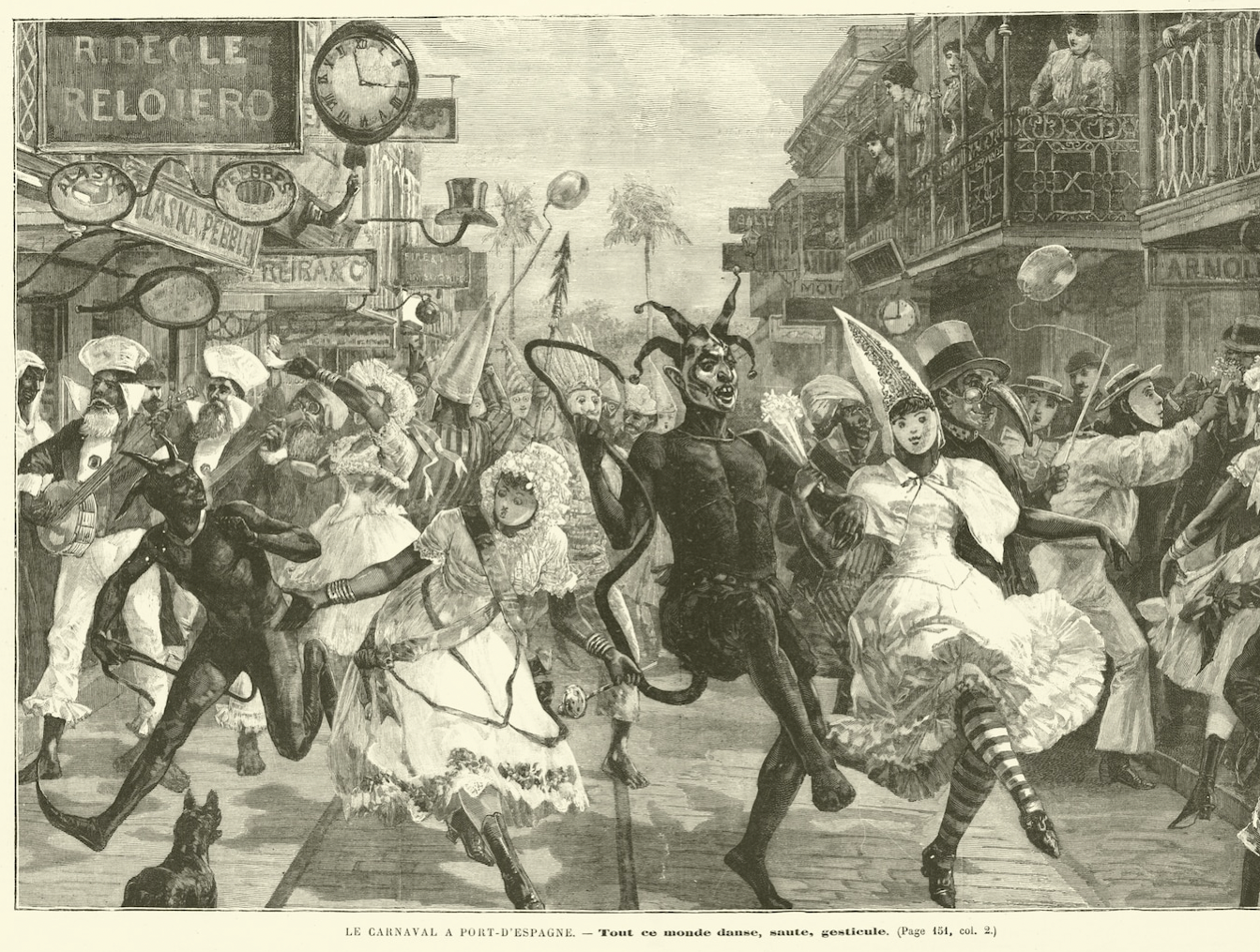
An illustration published in the Journal Des Voyages (1891) captures revelers at Carnival in Port of Spain, Trinidad.
The Era of the Plantocracy: A Celebration of Exclusion
In the 18th and early 19th centuries, Caribbean Carnival history looked nothing like the street parades we see today. Festivals were the private domain of the Plantocracy in colonial Caribbean territories. This occurred most notably in areas under Spanish and French influence.
The term “Plantocracy” refers to the white, landowning elite. These individuals held total social and political power. They hosted extravagant, “extra-legal” affairs involving masked balls and private dinners. Meanwhile, these festivities served as a constant reminder of exclusion for the enslaved population. Because the law banned Caribbean ancestors from participating, early Carnival iterations symbolized the very system that oppressed them.
1834: The Pivot Toward Cultural Resistance
The year 1834 marked a seismic shift. After the arrival of Emancipation, the formerly enslaved population did not simply walk away from observed traditions. Instead, they performed a brilliant act of cultural subversion.
This transition created a “metamorphosis” of the French Carnival model into something entirely new. Specifically, three key elements of resistance defined this change in Caribbean Carnival history:
Subversive Mockery: The freed population took to the streets in masks. They wore costumes that parodied the dress of the plantocracy. Therefore, they turned elite symbols into caricatures and used humor as a tool of defiance.
The African Infusion: People stripped back European structures to make room for Afro-centric traditions. The introduction of Kalinda (stick fighting) and traditional drumming reclaimed African heritage in public spaces.
The Canboulay Riots: This era saw the rise of Canboulay. These celebrations were rooted in resistance. Eventually, they led to clashes with colonial authorities who tried to suppress the drumming. Every beat of the drum declared their freedom.
Mapping the Evolution of Caribbean Carnival History
While the spirit of Carnival unifies the Caribbean, the historical “depth” varies significantly between islands. This shared history does not belong to one single territory. However, the timelines of its evolution remain distinct.
| Category | Historical Context | Examples |
|---|---|---|
| Deeply Rooted (200+ Years) | Islands where the fires of Emancipation forged Carnival immediately. | Trinidad & Tobago, Grenada, St. Vincent |
| Modern Adoption (Last 50 Years) | Islands that recently embraced the “street parade” to boost cultural tourism. | Jamaica, Bahamas, Bermuda |
The Commercial Tug-of-War: Culture vs. Capital
As we move into the 21st century, a new question arises in Caribbean Carnival history: Who truly owns the Mas in a globalized economy? This is where the “battle” shifts from physical resistance to economic and strategic positioning.
Today, the festival is a multi-million dollar industry. Large corporations now sponsor mas bands, and luxury “all-inclusive” packages have moved the festival toward a “masstige” market. While this brings essential investment to the islands, it also creates a tension between the grassroots origins and commercial interests. Some purists argue that the “pretty mas” of today—focused on high-end aesthetics—can sometimes overshadow the gritty, rebellious spirit of J’ouvert. However, this evolution is also a testament to the brand’s power; the people have turned a local ritual into a global economic engine.
The Global Diaspora and the Export of Liberation
The reach of Caribbean Carnival history does not stop at the shoreline of the Antilles. It has traveled in the suitcases and memories of the diaspora. In metropolises like London, New York, and Toronto, Carnival serves as a “home away from home.”
Events like Notting Hill Carnival or Brooklyn’s West Indian Day Parade are not just replicas. They are extensions of the original 1834 resistance. For Caribbean people living abroad, the Mas is a tool used to claim space in cities where they were once marginalized. By taking over the streets of London or the Eastern Parkway, the diaspora continues the legacy of using public performance to demand visibility and respect.
The Modern Psychology of Liberation
The festival has transitioned from a localized act of rebellion into a global brand. Today, people do not participate simply to watch a parade. Instead, they participate to experience a personal “metamorphosis.”
For one day, the social hierarchies of everyday life vanish. This echoes the original intent of the 1834 ancestors. Those ancestors used the Mas to reclaim their dignity and space. Because of this legacy, the modern reveler carries a torch of freedom lit centuries ago. You can see how these deep brand strategy principles influence the way we view cultural identity today.
Looking Ahead: The Summer of Mas
As the “Easter” Carnival cycle ends, the region prepares for the next wave. The countdown has begun for Vincy Mas in St. Vincent and Crop Over in Barbados. Additionally, the high-energy streets of St. Lucia will soon come alive.
Each island will bring its own flavor. You will hear unique Patois woven into the music and see specific craftsmanship in the costumes. Local traditions like J’ouvert will anchor the celebrations. Despite these local nuances, every reveler in the street belongs to the deep 200-year legacy of Caribbean Carnival history.
Carnival remains the Caribbean’s most successful “rebrand.” The people took a tool of the autocracy and turned it into a vibrant celebration of freedom. Ultimately, it serves as a reminder that while history may be written by the powerful, the culture is always defined by the people.
JANUARY 2026 CARNIVAL DATES
January: The Awakening
January: The Awakening
Sugar Mas & New Beginnings
The Event: St. Kitts & Nevis Sugar Mas (Ends Jan 2, 2026).
The Vibe: A sweet, high-energy transition from the holiday season into the first major road march of the year.
Pro-Tip: This is the perfect time to scout for early-bird costume registrations for the upcoming summer festivals.
FEBRUARY 2026 CARNIVAL DATES
February: The Peak of Passion
Pre-Lenten Revelry & Holy Grails
The Date: Trinidad & Tobago Carnival — February 16–17, 2026
The Vibe: The “Mother of all Carnivals.” This is where the world watches the pinnacle of costume design and soca music.
Pro-Tip: Book your “fetes” (parties) months in advance; the most prestigious events sell out by December.
Trinidad & Tobago Carnival Feb 16 – 17, 2026
Dominica (Mas Dominik) Feb 16 – 17, 2026
Guyana Mashramani Feb 23, 2026
APRIL 2026 CARNIVAL DATES

April: The Mid-Spring Surge
The Kingston Road March Season
The Date: Carnival in Jamaica — April 12, 2026
The Vibe: A massive urban takeover. Think high-fashion “masstige” aesthetics meeting the vibrant energy of Kingston.
Pro-Tip: Follow the local Mas Camps on Instagram early to see the theme reveals, as Jamaica often sets the trend for the “Summer of Mas.”
Jamaica Carnival Apr 8 – 14, 2026
Sint Maarten Carnival Apr 10 – May 5, 2026
MAY 2026 CARNIVAL DATES

May: The Carnival Convergence
May: The Carnival Convergence
Boutique Island Vibes & Turquoise Seas
The Date: Cayman Islands (Batabano) — May 2, 2026
The Vibe: Intimate, luxury-focused celebrations where the road march happens right alongside some of the world’s most beautiful beaches.
Pro-Tip: These islands offer a more “boutique” experience—perfect for travelers who want a high-end, less crowded parade.
JUNE 2026 CARNIVAL DATES
June: The Summer Solstice
The Date: Bermuda Carnival — June 12–15, 2026 | Vincy Mas (St. Vincent) — Begins June 26, 2026
The Vibe: Known as the “Hottest Carnival in the North,” it is deeply rooted in traditional drumming and intense energy.
Pro-Tip: Don’t miss the J’ouvert morning; it is one of the most authentic and traditional experiences in the region.
Bahamas Carnival Jun 3 – 7, 2026
Bermuda Carnival Jun 10 – 15, 2026
JULY 2026 CARNIVAL DATES


July: The Heat of the Heritage .The Mid-Summer Metamorphosis.
The Date: St. Lucia Carnival — July 20–21, 2026
The Vibe: A beautiful blend of Patois-infused music and some of the most intricate craftsmanship in modern costume design.
Pro-Tip: St. Lucia is the rising star of the Carnival world—make sure your travel arrangements are settled early.
1. St. Vincent (Vincy Mas) Jun 26 – Jul 7, 2026
2. St. Lucia Carnival Jul 1 – 22, 2026
3. Antigua Carnival Jul 23 – Aug 4, 2026
4. Barbados Crop Over Jul 29 – Aug 4, 2026
AUGUST 2026 CARNIVAL DATES
August: The Grand Finale
The Golden Standard: Crop Over & Spice Mas
The Date: Barbados Crop Over (Grand Kadooment) — August 3, 2026 | Grenada Spice Mas — August 10–11, 2026
The Vibe: The ultimate celebration of the harvest. From the star-studded streets of Barbados to the legendary “Jab Jab” energy of Grenada.
Pro-Tip: Keep an eye out for global fashion icons during Barbados’ Grand Kadooment—it’s the best place to see “Editorial Mas” in person.
Grenada Spicemas Aug 1 – 11, 2026
Anguilla Summer Festival Jul 24 – Aug 9, 2026
Notting Hill Carnival (UK) Aug 30 – 31, 2026
OCTOBER 2026 CARNIVAL DATES
October: The Autumn Mas
The Diaspora Junction
The Date: Miami Carnival — October 11, 2026
The Vibe: The largest gathering of the Caribbean diaspora in North America, acting as a high-octane reunion for all the islands.
Pro-Tip: Since this takes place at a fairground, comfort is key—look for “Monday Wear” style outfits that balance style with mobility.
Miami Carnival (USA) Oct 3 – 11, 2026
Tobago Carnival Oct 30 – Nov 1, 2026
DECEMBER 2026 CARNIVAL DATES
December: The Final Bow
Closing the Cultural Cycle
The Date: St. Croix Crucian Christmas Festival — December 2026 – Jan 2027
The Vibe: A festive, family-oriented wrap-up to the year that blends traditional Christmas spirit with the fire of the Mas.
Pro-Tip: This is the best time to experience “traditional” characters and folklore that date back to the origins of the 1834 resistance.
St. Kitts (Sugar Mas 2027) Dec 11 – Jan 2, 2027
Discover more from
Subscribe to get the latest posts sent to your email.